4-Year Training in Acceptance and Commitment Therapy (ACT)
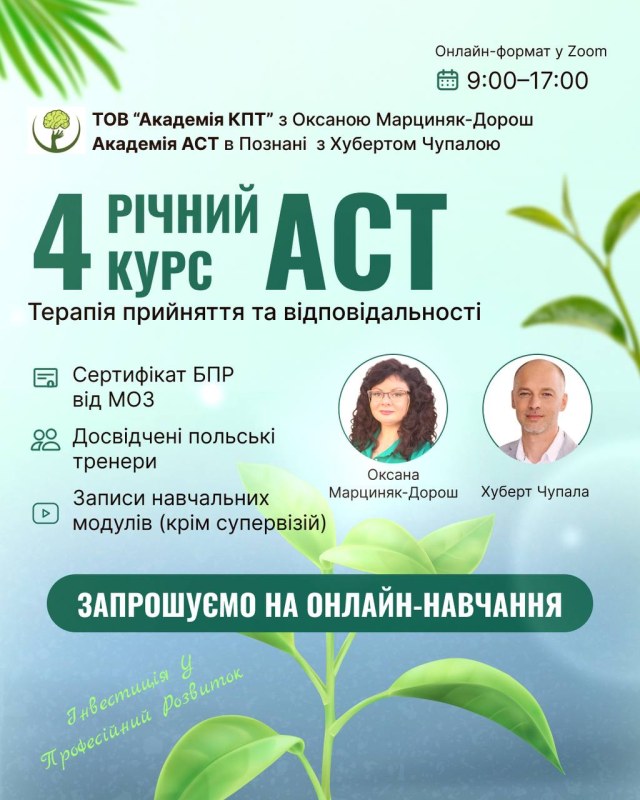
A four-year training program in Acceptance and Commitment Therapy (ACT) from the Cognitive Behavioral Therapy Academy with Oksana Martsynyak-Dorosh—a comprehensive educational program for psychologists, psychiatrists, physicians, rehabilitation specialists, nurses, and relevant students. The training focuses on mastering contextual behavioral science, modern ACT methods, DNA-V, and Functional Analytic Psychotherapy (FAP) in accordance with ACBS Peer Reviewed Trainers standards.
Duration: 4 years (800 academic hours of study, 160 hours of group supervision)
For whom: Psychologists, psychiatrists, physicians, rehabilitation specialists, nurses, 5th-year students in relevant fields, and individuals with a higher education degree who have completed a master’s program in psychology as a second specialty during the program.
Instructors: Hubert Czupała (ACBS Peer Reviewed Trainer), Oksana Martsynyak-Dorosh, and others.
Certification/Accreditation: The organizer notes that the program and trainers are aligned with the ACBS Polska community, and its foundations meet the standards of the global Association for Contextual Behavioral Science (ACBS). There is currently no official state accreditation due to the lack of relevant legislation in Ukraine and Poland.
The program offers a four-year deep dive into contextual behavioral sciences. The first year covers the foundations of psychotherapeutic practice, interpersonal training, Relational Frame Theory (RFT), and an introduction to FAP. In the second year, participants learn ACT applications in various clinical contexts (affective disorders, anxiety disorders, depression, OCD). The third year focuses on integration with other approaches, including CBT, schema therapy, CFT, DBT, and working with complex conditions. The fourth year explores working with diverse populations (PROSOCIAL groups, families, adolescents through the DNA-V model, couples, eating disorders) and somatic experience.
The training includes lectures, regular group online supervision sessions, clinical case studies, a book club, and practical workshops.